
RTI Implementation Review
Implemented as part of a consultation for Transparency Maldives (TM), the project:
Assesses implementation of RTI using the RTI Implementation Assessment methodology developed by the Centre for Law and Democracy (CLD)
Conducted a desk-based literature review and desk review of the proactive disclosure of the selected state institutions
Carried out key-informant reviews in order to gauge the central and institutional measures in place to implement
RTI provisions
Conducted visits to the office premises to observe whether proactive disclosure information was available at the office in any physical form
This study aims to provide an assessment of the implementation of the RTI Act and regulation by
- Assessing the work of the Information Commissioner's Office (ICO);
- Studying the measures in place for implementation of the Act at public authorities;
- Monitoring the proactive disclosure obligations of public authorities beyond just the requirements under the RTI Act; and
- Assessing the reaction from public authorities in response to formal RTI requests.
Given the large number of public authorities in any given jurisdiction, the methodology does not attempt to measure the performance of all public authorities, but rather a sample of public authorities from each jurisdiction, in addition to the oversight body.
This assessment, aimed at evaluating the efficacy of reactive disclosure mechanisms, was conducted across 30 diverse public authorities. All authorities under the jurisdiction of the RTI Act that had received RTI requests were grouped by Ministries, Statutory bodies, constitutional bodies, health sector, education sector, city councils, atoll councils, northern and southern island councils, Judiciary, State Owned Enterprises and a category for others. The public authorities in these categories were divided into high and low RTI requests receiving public authorities by averaging the total number of RTI requests received in the category and using the value as a median. One public authority was selected from the high and low sections separately using a random sample selection for each category. Additionally, the President’s Office, Peoples Majlis (The Parliament) and Supreme Court were selected as the heads of the three branches of State.
| # | Name of Public Authority | Type of Public Authority |
|---|---|---|
| 1 | President's Office | Head of Executive |
| 2 | Ministry of Health | Executive Ministry |
| 3 | Ministry of Defence | Executive Ministry |
| 4 | Ministry of Education | Executive Ministry |
| 5 | Ministry of Transport & Civil Aviation | Executive Ministry |
| 6 | Ministry of Higher Education, Labour and Skills Development | Executive Ministry |
| 7 | Maldives Police Service | Executive Institution |
| 8 | Maldives Correctional Service | Executive Institution |
| 9 | Department of National Registration | Executive Institution |
| 10 | Maldives Immigration | Executive Institution |
| 11 | ADh. Dhigurah Health Center | Executive Institution |
| 12 | People's Majlis | Head of Legislative |
| 13 | Supreme Court | Head of Judiciary |
| 14 | Department of Judicial Administration | Judicial Administration |
| 15 | Fuvahmulah Magistrate Court | Judicial Court |
| 16 | Judicial Service Commission | Statutory Body |
| 17 | Maldives Inland Revenue Authority | Statutory Body |
| 18 | Elections Commission | Statutory Body |
| 19 | Maldives International Arbitration Center | Statutory Body |
| 20 | Islamic University of Maldives | Statutory Body |
| 21 | HA. Ihavandhoo Council | Local Government – Island Council |
| 22 | Sh. Maroshi Council | Local Government – Island Council |
| 23 | B. Thulhaadhoo Council | Local Government – Island Council |
| 24 | K. Maafushi Council | Local Government – Island Council |
| 25 | AA. Rasdhoo Council | Local Government – Island Council |
| 26 | L. Maabaidhoo Council | Local Government – Island Council |
| 27 | Lh. Atoll Council | Local Government – Atoll Council |
| 28 | Fuvahmulah City Council | Local Government – City Council |
| 29 | Maldives Hajj Corporation | State-Owned Enterprise |
| 30 | Fenaka Corporation | State-Owned Enterprise |
As part of the assessment, a series of structured interviews was conducted with six RTI practitioners in the Maldives, including journalists, members of CSOs, and individuals who have experience in requesting for information using the RTI framework. This section presents the key findings from these interviews, highlighting the perceptions and experiences of these practitioners.
There is a consensus among practitioners that ICO currently operates with a reasonable degree of independence. Some interviewees expressed that this independence is largely attributed to the current Commissioner’s commitment to impartiality and expressed concerns over the independence if successive Commissioners are less committed to these principles.
Funding sources of ICO was also a contentious topic. While some practitioners acknowledged an increase in the office’s budget and argued that the institution should focus on improving its financial management and better utilizing the available budget, others maintained that the office remains underfunded and understaffed, necessitating further budgetary support.
RTI practitioners interviewed generally agreed that while the process is often lengthy, the remedies and resolutions provided by ICO are deemed satisfactory. However, RTI procedures within public authorities were also identified as an area of concern, with many KIIs reporting that Information Officers in various state agencies face pressure, which leads to delays and, at times, to withholding of information. These delays are perceived as deliberate tactics, especially when requests are made by journalists and the requests are for information of public interest. Journalists within the group particularly emphasized that they feel targeted, with public authorities often abusing provisions in the RTI law to extend deadlines for information release without valid reasons.
Despite these challenges, there is broad recognition among practitioners that mechanisms for submitting information requests are straightforward and accessible. However, the difficulty, they noted, lies in obtaining the requested information. This reflects a significant gap between the accessibility of the RTI request process and the actual fulfillment of those requests by state agencies. Furthermore, practitioners were unanimous in their view that public authorities do not
adequately comply with the RTI Act’s requirements for proactive information disclosure. Some practitioners claimed that certain public authorities were
unaware of the legal mandate to proactively disclose specific information, highlighting a critical area for institutional improvement.
The overall assessment indicates an increase in awareness of the RTI framework among the Maldivian public over the past decade. Practitioners agreed that public interest and engagement with RTI have increased, making the law an essential tool for promoting transparency. Nevertheless, they emphasized the need for the state to enhance the protection and enforcement of citizens' RTI, ensuring that institutional practices align more closely with the legal standards set forth in the RTI legislation. This feedback underscores the importance of continued efforts to strengthen the implementation and enforcement of RTI laws, including ensuring the independence of ICO, providing adequate funding, and addressing systemic delays and external influences affecting Information Officers.
The assessment of ICO was conducted solely by TM. Under the RTI Act, the responsibilities for overseeing the implementation and enforcement of the law are vested in ICO. The assessment looked at the institutional measures at ICO to facilitate the implementation of the RTI Act and whether ICO is effective in fulfilling its mandate. The performance of ICO was assessed through KIIs and based on a set of objective and qualitative criteria. The KIIs included input from the Information Commissioner, ICO staff, RTI practitioners, CSOs and journalists. Each item in the objective evaluation was rated on a scale from 0 to 1, with 1 representing a fully met criterion, and 0 representing an unmet criterion, while the items in the qualitative evaluation could also be awarded a 0.5 for a partially met criterion. Finally, ICO was provided with an overall grade based on the sum average of the objective and qualitative evaluations.
| # | Scoring Area | Score |
|---|---|---|
| Objective Evaluation (Yes = 1; No = 0) | ||
| 1 | Has funding been allocated? | 1 |
| 2 | Does the body recruit its own staff? | 1 |
| 3 | Are the body's appeals decisions available online? | 1 |
| 4 | Has the body produced and published an annual report for the last two years? | 1 |
| 5 | Has the body published a guide for requesters? | 1 |
| Average (Objective Evaluation) | 1 | |
| Qualitative Evaluation (Strongly = 1; Partially = 0.5; Weakly = 0) | ||
| 6 | Have the members been appointed? | 1 |
| 7 | Are the members of the body independent and effective? | 0.5 |
| 8 | Is the funding provided to the body reasonably sufficient for it to discharge its functions? | 0 |
| 9 | Does the body decide appeals in a timely fashion? | 0.5 |
| 10 | Are the due process rights of parties respected during appeals? | 1 |
| 11 | Has the body made reasonable efforts to raise public awareness? | 0.5 |
| 12 | Have effective measures been taken to provide training to officials? | 1 |
| 13 | Has the body made a reasonable effort to comment on draft laws which affect the RTI? | 1 |
| Average (Qualitative Evaluation) | 0.69 | |
| Average | 0.81 | |
| Overall Grade | GREEN |
Recommendations
Based on the findings of the evaluation, the following recommendations are proposed to strengthen the central measures in the implementation of RTI measures:
Ensure the commission is equipped with the necessary financial, human resources and technical capacity to meet the growing workload and carry out its mandate.
Develop a formal training module for newly appointed Information Commissioners to ensure that they are aware of the legal requirements of the position, and they are up-to date on any new developments in the RTI regime.
Increase accountability and monitoring of ICO’s work by the Independent Institutions Committee at the People’s Majlis to ensure proper functioning of the office and impartiality of the Commissioner.
Build the capacity of ICO by providing relevant training to the staff in different sections of the office.
Increase ICO’s efforts to raise public awareness and train officials at public authorities. Formulate and disseminate targeted materials accessible to people with disabilities.
The Government and the Parliament must ensure timely appointment of future information commissioners to guarantee that the work of the commission is not impeded, and they are able to fulfil their mandate effectively.
Grading for each public authority for this assessment area was based on ten criteria in the objective evaluation and four criteria in the qualitative evaluation. For each criterion in the objective evaluation, public authorities were awarded 1 if the criterion was met, or 0 if not. Qualitative evaluation criteria also considered how strongly each criterion was met, with 1 awarded for a strongly met criterion, 0.5 if the criterion was partially met, or 0 if the criterion was met weakly, or not at all.
Objective Evaluation
Public authorities were evaluated on ten areas in the objective evaluation of their institutional measures. The first of these areas pertained to the appointment of Information Officers at public authorities, and as all the authorities assessed had an Information Officer appointed, the category had a full score of 1. However, only seven (30%) of these public authorities had the responsibilities of the Information Officer included in the Terms of Reference (ToR) or job description of the assigned employee. The evaluation also investigated whether a person who is different from the Information Officer had been appointed to deal with internal complaints – which is also a requirement under the RTI Act which requires having a review committee of no less than three members to review complaints regarding decisions of the Information Officer. All evaluated public authorities apart from two fulfilled this requirement, and hence this category was tied for the second highest average score at 0.91. The only legal consideration required in the appointment of the Information Officer and the members of the review committee by public authorities is to ensure that the members of the review committee are of a higher rank than the Information Officer. Furthermore, as neither of these positions are standalone positions but rather an added responsibility placed on existing staff, appropriate equipment is available to carry out their responsibilities under the RTI Act as well.
One of two areas of the objective evaluation in which all assessed public authorities scored 0 pertained to the adoption of RTI implementation plans. In addition to these, authorities were also asked about whether they have adopted any set of guidelines on how to process RTI requests. Of the 23 public authorities that were assessed, only three (13%) were noted as having fulfilled this requirement. The rest of the authorities claimed that they followed the RTI Act rather than developing and adopting a separate standard operating procedure (SOP) or guideline to process requests. Information Officers at 74% of public authorities also reported having received training, although some of them noted requiring more training. One respondent claimed that the training they had attended was held online and did not find it sufficient, while another noted that the training they received was inadequate.
Public authorities were also assessed on the process to lodge RTI requests with the authority in electronic format and whether it was easy to obtain the RTI request form and contact details of the Information Officer. All of the assessed public authorities apart from two, were registered on the Mahoali portal developed by ICO, resulting in a score of 91% for this category. Registering on the portal simultaneously fulfills the requirements for this category as it provides the public with the means to lodge an RTI request with the authority in electronic format and provides a means to contact the Information Officer. Contact details of the registered Information Officers are also separately made available on ICO’s website. Registering on the Mahoali portal is by no means the only way to fulfill these requirements however, as authorities could also provide this information through their respective websites. The two authorities that scored 0 in this category did not have their own website either.
All the public authorities assessed had submitted their annual report to ICO as required by the RTI Act. However, not a single authority was noted to have made any effort to raise awareness on RTI for the public. Lastly, public authorities were questioned on their attempts to improve records management, to which 19 authorities (83%) described many different ways in which they were attempting to improve their respective records management systems. Most of these actions related to the digitization of records, although some public authorities also noted improvements to their archiving systems.
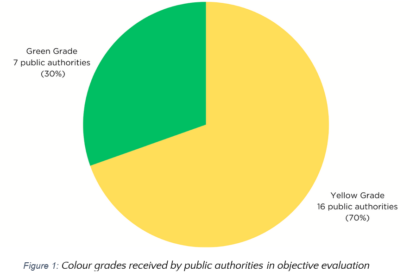
In the objective evaluation of institutional measures, seven public authorities (30%) received a green grade, while the remaining 16 public authorities (70%) all received a yellow grade. The colour grades received by public authorities in the objective evaluation of institutional measures are summarized in Figure 1 below.
Average: 0.58
Qualitative Evaluation
Four different areas were assessed in the qualitative evaluation of implementation measures. Firstly, Information Officers were questioned about the level of outside pressure (political or any other) and whether there were any such difficulties for them to carry out their duties. None of the Information Officers questioned for the evaluation noted any such challenge. However, this directly contradicts the experience shared by information seekers who reported delays and challenges in the provision of information due to external pressure on Information Officers and may indicate hesitancy to disclose challenges faced for fear of retaliation or confidentiality by their respective authorities. Information Officers were also questioned on whether they were allocated appropriate time to carry out their responsibilities as Information Officers. As Information Officers are not standalone positions, but rather an added responsibility placed on existing staff, Information Officers are essentially required to balance the responsibilities of two positions. Despite this, however, some Information Officers noted not requiring additional time, and only a little more than half of Information Officers interviewed (54%) noted having been allocated time to do their job as Information Officers. The RTI Act does not require Information Officers to have any specific qualifications.
Public authorities were then assessed on the strength of their RTI implementation plan or SOP, and the extent of their awareness raising activities. However, as none of the assessed public authorities had formulated such an implementation plan, nor conducted any activities to raise awareness on RTI, both categories had a score of 0. Many of the issues regarding the processing of RTI requests could stem from this lack of internal planning from public authorities. Additionally, the lack of awareness raising activities also signify a lack of political will from public authorities to promote the fundamental RTI.
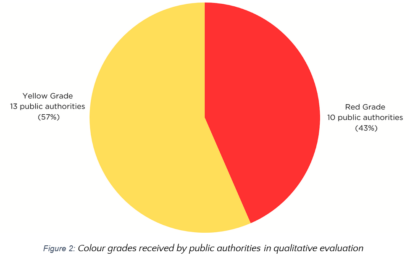
In the qualitative evaluation of institutional measures, 10 public authorities (43%) received a red grade, while the remaining 13 public authorities (57%) all received a yellow grade. The colour grades received by public authorities in the qualitative evaluation of institutional measures are summarized in the Figure 2 below.
Average: 0.39
Overall Assessment
Public authorities assessed for their implementation measures had a wide range of scores, with some categories averaging full to very high scores of 1 – 0.9, while other categories averaged scores ranging from 0 – 0.3. All of the public authorities assessed had appointed an Information Officer, and most (74%) among them had been provided with training as well. Although only 30% of Information Officers had been formally given the responsibilities of the Information Officers through a ToR or through inclusion in their job description, all of the Information Officers interviewed reported being free from external pressures in carrying out their duties. However, this directly contravenes the experience of information seekers, many of whom highlighted delays and refusals from the decision makers at public authorities above the Information Officer rank.
Due to the Mahoali portal that was developed by ICO, it is currently possible to lodge RTI requests with a vast majority of the public authorities (91%) and all but two of the authorities had set up the legally mandated review committee to deal with internal complaints. All of the authorities assessed were also recorded as having submitted their annual report to ICO.
Areas that need improvement include adopting guidelines for the processing of RTI requests, setting up strong implementation plans or SOPs for the fulfillment of RTI provisions, as well as carrying out extensive public awareness raising activities.
The overall grade for the assessment of implementation measures at public authorities resulted in a yellow grade, with all 23 public authorities assessed individually receiving yellow grades as well.
Average Score: 0.53
Overall Grade: Yellow
Recommendations
Based on the evaluation findings, the following recommendations are proposed to strengthen the implementation and effectiveness of RTI practices across public authorities:
Public authorities should integrate the roles and responsibilities of Information Officers into their official ToR or job descriptions. This formal recognition will ensure accountability and clarity in the performance of Information Officers duties and strengthen the overall RTI framework.
Public authorities should prioritize the creation and adoption of implementation plans for processing RTI requests. These documents should detail the steps and standards to be followed, ensuring consistency and efficiency in handling requests. Training staff on these plans and procedures would further reinforce effective information management.
Information seekers note both delays in the provision of information and the withholding of information due to external pressure on Information Officers. As Information Officers are legally empowered to make decisions on RTI requests in the first stage of the RTI process, the implementation of SOPs to ensure independence in their decision-making could greatly enhance the RTI process.
Comprehensive training programs should be provided to Information Officers to equip them with the necessary skills and knowledge to fulfill their responsibilities effectively. Training should cover the nuances of the RTI Act, best practices for managing requests, and strategies for handling challenges, including potential external pressures.
Public authorities should organize regular awareness-raising campaigns to educate the public on their RTI and how to access it. These campaigns could include workshops, media outreach, and public events to increase engagement and awareness. Additionally, ongoing capacity-building programs should be conducted to keep Information Officers and other relevant staff updated on best practices and new developments in information management.
Proactive disclosure as stated under Section 37 of the RTI Act refers to the information required to be proactively disclosed by public authorities without the need for filing an RTI request. These 13 categories of information under the RTI Act are intended to make information publicly available through the institute’s website or other accessible platforms. Public authorities are required to proactively disclose this information on an annual basis, or in a shorter period decided by the public authority.
Furthermore, Section 36(a) requires the following details of the Information Officers at public authorities to be made publicly available and disseminated as widely as possible.
- Names
- Designations
- Contact details
For measuring the proactive disclosure rates of the selected public authorities, the level of information that was proactively disclosed by each selected authority for each of the 13 categories under Section 37 and 3 categories under Section 36(a) were assessed. All these categories were further broken down into 26 sub-categories or specific information so that scores could be assigned based on whether the specific information was available. Details of how each subsection was broken down into individual items are presented in Table 6.
A 5-point scale was used to score public authorities based on the availability of the information. For each of the subcategories or specific information that was required to be published, each authority was given one of the following evaluations based on how extensive the publication was: Full, Full to Partial, Partial, Partial to None or None. Several factors were considered in assessing how extensive the publications were. This included:
- Whether the available information was complete in the sense of including everything in the relevant category
- How easy the information was to find
- How up to date the information was, taking into account how frequently that type of information changes
Depending on the evaluation for each item, the respective score and color was assigned as according to Table 7 and the final point scores consisting of the average of all substantive and other issues assessed for each public authority was converted to a final colour grade.
Substantive Issues
The average substantive score among all 30 public authorities was a very low yellow, indicating very low levels of proactive disclosure among authorities. Only Fuvamulah City Council and Election Commission of the Maldives received a full 1.00 substantive score, while three other authorities also received green grades. Conversely, six public authorities; ADh. Dhigurah Health Center, K. Maafushi Council, Sh. Maroshi Council, HA. Ihavandhoo Council, B. Thulhaadhoo Council and AA. Rasdhoo Council all received a zero on their substantive scores due to the absence of a functional website containing the information required to be proactively disclosed.
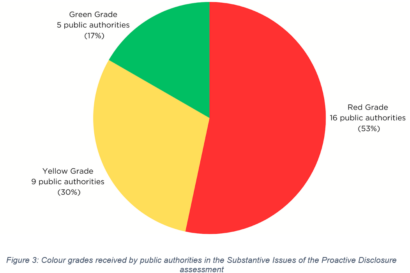
A total of five authorities (17%) received an overall green grade in the disclosure of information pertaining to substantive issues, while nine authorities (30%) received a yellow grade, and 16 authorities (53%) received a red grade. Details of the complaints received by public authorities and details of the authorities' budget, including details of disbursements made, were areas highlighted as needing the most improvement. The colour grades received by public authorities in the substantive issues section of the proactive disclosure assessment are summarized in Figure 3 below.
Average Score: 0.37
Overall Grade: Yellow
Other Issues
In addition to the substantive issues required to be proactively disclosed under the RTI Act, public authorities were also assessed on other issues pertaining to efforts made in the dissemination of information to the public. This included assessment of
- The efforts made by the public authority in disseminating information other than simply via its website;
- The efforts made by the public authority in its use of social media or other means to draw the attention of the public to its proactive publications (and to provide key information directly to the public)
- The efforts made by the public authority to create understandable versions of at least the most important documents (such as its budget)
- How reasonably easy it was to find specific information from among all of the information that is being published online.
While the methodology also included assessment of whether public authority’s websites were Web Content Accessibility Guidelines (WCAG) 2.1 compliant, this category was not considered. There are currently no laws or regulations in the Maldives mandating the websites of public authorities to comply with WCAG, nor has there been any advocacy to make the websites of public authorities WCAG compliant. Therefore, public authorities in Maldives are not aware of the guidelines and all public authorities assessed would have scored 0 in this category.
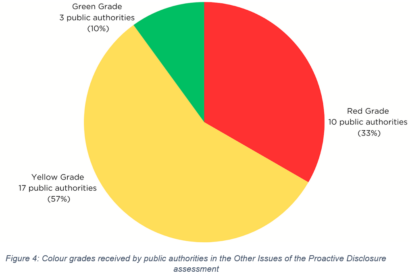
Maldives Inland Revenue Authority scored the highest in this assessment area with a score of 0.94 out of 1. Ministry of Health and the Election’s Commission also scored a green grade with a score of 0.75 out of 1. These three public authorities (10%) were the only ones to receive a green grade, while 17 authorities (57%) received a yellow grade, and 10 authorities (33%) received a red grade. The areas with the weakest scores were in the assessment of efforts made by authorities to create understandable versions of the most important documents, as well as the use of social media to provide key information. A summary of the colour grades received by public authorities in the assessment of other issues pertaining to proactive disclosure are visualized in Figure 4.
Average Score: 0.39
Overall Grade: Yellow
Overall Assessment
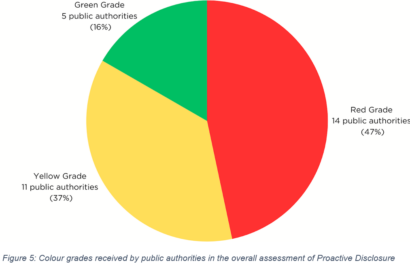
Out of the 30 public authorities assessed, five authorities (16%) received an overall green grade, 11 authorities (37%) received an overall yellow grade, and 14 authorities (47%) received a red grade. The final grade was calculated by taking 75% of the first point score (i.e. the points for proactive disclosure online classified as substantive issues in this assessment) and 25% of the second point score (i.e. the points for the four other issues).
The five public authorities that received a green grade included the People’s Majlis, Department of Judicial Administration, Maldives Inland Revenue Authority, Elections Commission and Fuvahmulah City Council. The highest overall score was received by the Elections Commission with 0.92 out of 1, followed by Fuvahmulah City Council at 0.89. The colour grades received by public authorities in the overall assessment of proactive disclosure are summarized in Figure 5 below.
Average Score: 0.38
Overall Grade: Yellow
Recommendations
Based on the evaluation findings, the following recommendations are proposed to strengthen the implementation and effectiveness of RTI practices across public authorities:
Efforts must be made for the development and maintenance of websites of local councils and smaller public authorities. The capacity and resources for the maintenance of websites that fulfill the requirements of proactive disclosure must be provided.
Complex, yet critical information such as matters relating to budgets and policies must be simplified and made easier for users to understand. In cases where public authorities are unable to publish information on the authority’s website, increased efforts are required to make the information accessible through other means, such as through authorities’ social media pages.
More efforts need to be carried out for training and capacity building of public authorities to help the Information Officer, management and other staff understand the need, rationale, importance and advantages of proactively disclosing information. Specialized training should also be given to the Information Officer and other relevant staff responsible for content creation on how to effectively simplify information for the public and disseminate information in various accessible formats.
Reactive disclosure is defined as a public authority's provision of information in response to a formal request, typically governed by frameworks such as the RTI Act. This assessment, aimed at evaluating the efficacy and functionality of reactive disclosure mechanisms, was conducted by lodging two formal requests for information from each public authority and then monitoring how the authority responded to those requests. The assessment looked at several different factors in the processing of RTI requests, including whether a receipt was provided, whether a timely response was provided and whether a fee was charged, as well as the overall result of the request (i.e. whether the requested information was provided in full).
Information requests
To evaluate compliance with the RTI Act, each of the 30 public authorities was subjected to two information requests, one easy request and one difficult request. The requests were categorized as outlined below:
- Exemption: Requests where the information might be exempt due to legal protections, such as confidentiality or security concerns. This tested the public authority's ability to clearly justify why certain information could not be disclosed.
- Larger Volume of Information: These requests involved substantial volumes of data, requiring significant effort to compile. The authorities were evaluated on their ability to handle resource-intensive requests while meeting legal timelines.
- Public Interest: Requests related to matters of high public interest. This level assessed how public authorities navigated the balance between transparency and the protection of sensitive information.
- Transfer Question: In cases where the public authority did not hold the requested information, the "transfer question" category assessed how efficiently the request was forwarded to the appropriate public authority without causing delays.
- Easy: Simple, routine requests for non-sensitive information. This category served as a baseline for evaluating the efficiency of handling straightforward inquiries.
Additionally, the requests were delivered using five different modes: via the Mahoali Portal, using the RTI Application Form (both physically and as an email attachment), and as a general letter (delivered physically or as an email), in a mix of English and Dhivehi language. The variety of submission methods was intended to assess the public authority’s' responsiveness across different communication platforms and their ability to process requests regardless of the format.
Evaluation
The reactive disclosure evaluation was based on several key performance indicators:
Processing Score
- This score was composed of three sub-scores, each evaluated on a binary YES (1 point) or NO (0 points) basis:
- Receipt score: Whether a receipt was provided to the requester.
- Timeliness score: Whether the request was responded to within the 21-day deadline limit, including any extensions that complied with legal rules and were reasonable.
- Fee score: Whether any charged fee adhered to the legal requirements.
The average of these three sub-scores provided the processing score for each request.
Average Receipt score: 0.37
Average Timeliness score: 0.50
Average Fee score: 1.00
Average Processing score: 0.62
Processing Score Grade: Yellow
Result Score
- This score evaluated the outcome of the request based on the quality and completeness of the response:
- Full disclosure: Awarded 1 point for valid and complete information disclosure.
- Oral refusals or mute refusals (failure to respond within the deadline) and cases where it was not possible to lodge the RTI request: 0 points (considered never valid).
- Other responses (e.g., written refusal, partial disclosure, referral to another authority, or incomplete answers) were assessed based on validity:
- LIKELY valid: 1 point.
- MAYBE valid: 0.5 points.
- UNLIKELY valid: 0 points.
Average Results Score: 0.48
Results Score Grade: Yellow
The overall score for each request was calculated by adding one-third of the processing score and two-thirds of the result score. The final score for each public authority was determined by averaging the scores across both RTI requests submitted to that authority. The overall jurisdiction score was then calculated by averaging the scores for all requests, ensuring consistency in the evaluation process across multiple authorities.
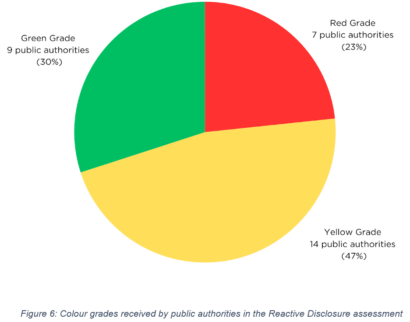
The results of the Reactive Disclosure assessment are summarized in Figure 6 below:
Overall Assessment
The overall score for the Reactive Disclosure assessment is yellow with an average final score of 0.52 which indicates a need for improvement across the board. Seven public authorities (23%) received a red score, while 14 authorities (47%) received a yellow score. Nine public authorities (30%) received green scores, although there was only one public authority: the Fuvamulah Magistrate Court which received a perfect score of 1.
Of the total 60 requests submitted, 14 requests (23%) did not receive any sort of communication from the authority. There was also one instance where an authority refused to accept the physical RTI form, and the information seeker was asked to submit the request through the portal instead. The request was accepted and acknowledged when it was submitted through the portal, though the requested information was never provided. There were eight instances (13%) where public authorities acknowledged the request by providing a receipt, but the information was not provided, and three instances (5%) where the deadline for responding to the request was extended by the authority, but the information was not provided. All 14 of the refusals to provide information were mute refusals.
The requested information was provided in full for 27 requests (45%), of which, four requests (7%) only received a response after the deadline. This means that only 23 requests (38%) received the requested information in full, before the deadline stipulated in the Act. The requested information was only partially provided for seven requests (12%), of which, the information for one request was provided after the 21-day deadline.
Public authorities assessed fared well in processing stage of the easy requests. However, information was received in full before the deadline for only 10 out of the 30 requests, and a further two responses after the deadline. Partial information was provided for five requests. The remaining 13 requests were not answered to, with five of these requests also not being acknowledged through a receipt during the processing phase. The processing score for the difficult requests was slightly lower than the easy requests. Five requests were submitted that required the receiving public authority to transfer the request to another public authority and three of these requests were met with no responses and information was received in full for only one request. Among the eight requests under the exemption category, a full response noting exemptions with reference to the RTI Act was sent before the deadline by three public authorities. 13 requests were sent requesting information that was large in volume and seven responses were received in full before the deadline. Four requests were submitted in the public interest category with two being answered in full before the deadline and the other two receiving no responses during the entire process.
Among the variety of methods that were utilized to submit the requests, requests through the Mahoali portal were the most responsive method with 11 of 16 (69%) requests receiving a full response. Requests sent using physical letters did not receive any full response (0 of 6). However, 5 of 12 (42%) of physical form requests received a full response while 4 of 11 (36%) requests sent via email body and 7 of 15 (47%) requests received full responses. These results indicate that Information Officers and public authorities are familiar and responsive to the Mahoali portal. Some requests that were submitted using email or physically were asked to be resubmitted through the portal by some public authorities. This indicates that there is a misconception among Information Officers and institutions that requests have to be submitted only through the portal.
The RTI requests were divided by gender, with an equal split between submissions from men and women. Of the requests submitted by men, 53% (16 out of 30) received the requested information in full, while only 37% (11 out of 30) of requests from women were fully processed. Women submitted 14 difficult requests and 16 easy requests while men submitted 16 difficult requests and 14 easy requests.
Based on the available data and sample size a gender bias cannot clearly be established as the responses may have also been affected by other factors such as the difficulty of the requests, the method used to request information and overall compliance of the public authority for the RTI act.
The overall average process score for the public authorities was 0.62 compared to 0.48 for the results score, which indicates that while most authorities provided receipts and responses in a timely manner as required by law, the actual information requested was not provided in many cases.
Average Final Score: 0.52
Overall Grade: Yellow
Recommendations
Based on the evaluation findings, the following recommendations are proposed to strengthen the implementation and effectiveness of RTI practices across public authorities:
In order to streamline the processing of RTI requests submitted to public authorities, and to ensure that RTI requests are not missed, each public authority should develop their own implementation plan based on the provisions of the RTI Act. The plan should lay out in detail the process of gathering, publishing and providing information to requesters, as well as the parties responsible for each step, and focal points to contact from different departments or sections.
Enhanced training should be provided to Information Officers, senior officials and front office staff to equip them with the knowledge to strengthen the processing of requests and ensure compliance with the RTI Act.
In cases of refusals, the Information Commissioner has the power to apply a range of different accountability measures on the public authorities, or the personnel responsible for processing the requests. The application of such measures, especially for repeated infringements, will increase accountability and improve institutional capacity to process RTI requests according to law.
Given the potential presence of gender biases in the processing of RTI requests, further research is needed to identify whether such biases exist and identify the factors that may contribute to them.
The evaluation of all 30 public authorities in the sample was completed for both the assessment of Proactive Disclosure and Reactive Disclosure of public authorities. KIIs to measure institutional measures were completed for 23 out of 30 public authorities. The overall final scores and grades presented in Table 12 below, represent the assessment of the 23 authorities for which the full assessment across all 3 areas could be completed.
The overall average grade for the country is a high yellow, which signifies that while there were some positive results, there is still a lot of room for improvement across the board. Only the assessment of the Central Measures yielded a score higher than the threshold for a green grade, while both Institutional Measures and Reactive Disclosure received similar scores for a yellow grade. The grade for Proactive Disclosure was a very low yellow, just barely passing the yellow grade mark.
From the 23 authorities for which the full assessment across all three areas could be completed, only four public authorities (17%) passed the threshold for a green grade while 14 public authorities (61%) received a yellow grade, and five public authorities (22%) received a red grade.
The four public authorities that received a green grade included the People’s Majlis, Maldives Immigration, Fuvahmulah City Council and Elections Commission. The results for all 30 public authorities assessed under the assessment, including the result for each area of assessment, as well as the overall average, percentage and colour grade are provided in Table 13 below:
Conclusion
The overall final yellow grade, with an average score of 0.56, with 3 out of 4 assessment areas also scoring a yellow grade, signify a need for improvement across all areas in the implementation of the RTI Act in Maldives. Measures to ensure the continued impartiality and financial independence of ICO were highlighted as areas requiring improvement from both the Practitioners’ Assessment, as well as the assessment of Central Measures. Issues concerning the appointment of new Information Commissioners were also noted, as none of the newly appointed Commissioners were able to be appointed within the timeframe specified in the RTI Act. While ICO does not have the power to influence the appointment process, the onboarding process for newly appointed Information Commissioners could be greatly improved, as there are currently no procedures in place to provide them with any sort of training or onboarding programs by any of the institutions involved in the appointment of the Commissioner, nor by ICO. Nevertheless, the assessment of the Central Measures yielded an overall green grade, owing to a perfect score in the objective evaluation.
RTI procedures within public authorities were also identified as an area of concern requiring improvement, with informants in various state agencies reporting that Information Officers face pressure from decision makers within public authorities, leading to delays and, at times, the withholding of information altogether. These issues are further exacerbated by the lack of RTI implementation plans, relevant SOPs or guidelines on how to process RTI requests by public authorities. As a result, public authorities often struggle to provide requested information in full, and on time. It was observed that public authorities fared better in processing RTI requests than in providing the requested information. Enhancing the proactive disclosure of information is not only required by law but can also help public authorities in processing their RTI requests, as it would ultimately lead to a reduction in the number of requests for information being submitted.
Many of the recommendations for improvements across the different assessment areas are similar and involve measures such as building the capacity of relevant staff, increasing accountability for responsible personnel, adopting RTI implementation plans, and strengthening the online infrastructure of public authorities.