
Proactive Disclosure Review 2023
Implemented as part of a consultation for Transparency Maldives (TM), the project was aimed at:
Monitoring the overall rate of disclosure by all State Institutions
Studying the variation in level of proactive disclosure by different kinds of State Institutions.
Identifying challenges and ways to improve disclosure by State Institutions
Highlighting key trends in how State Institutions currently disclose information
The websites of 935 institutions state institutions from the following types of state institutions were monitored for this study:
- Executive;
- Legislature;
- Judiciary;
- Statutory Bodies;
- Local Government;
- Government Funded Health Service Providers;
- Academic Institutions;
- Political Parties; and
- State-Owned Enterprises (SOEs)
Data for the review was collected by 10 interns who were hired and trained to assess the websites and publications on the websites of state institutions during a one month period from November – December 2023. As some subsections of Section 37 and subsection 36(a) of the Act require multiple pieces of information to be disclosed, each subsection was further broken down into individual items, with each item fully disclosed, granting a score of 1. Each intern was randomly assigned 93 – 94 institutions to assess, and each institution was scored based on the availability of the individual items on their respective websites.
The 13 subsections from Section 37 & Subsection 36 (a) of the RTI Act were broken down into 25 items to be monitored for disclosure.
| # | Subsection | # | Breakdown | |
|---|---|---|---|---|
| 37 (a) | Details of the functions, responsibilities, structure and duties of the Institution | 1 | Institution's duties / functions / responsibilities | |
| 2 | Instiution's structure | |||
| 37 (b) | Details of direct services provided or being provided to the public | 3 | Direct services provided or being provided to the public | |
| 37 (c) | Details of the mechanism of lodging a complaint at the Institution in connection to a matter undertaken by that office, and details of the number of complaints received thus far | 4 | Mechanism of lodging a complaint | |
| 5 | Details of the complaints received | |||
| 37 (d) | Easily comprehensible details of how documents are managed | 6 | Details of how documents are managed | |
| 37 (e) | Information held or maintained by the Institution, and the nature of its general publications, together with information on the procedure to follow to request for information | 7 | Nature of general publications | |
| 8 | Procedure to follow to request for information | |||
| 37 (f) | The responsibilities and duties of high ranking officials of the Institution, their powers and scope of discretion, and procedure followed in decision making within that scope | 9 | The responsibilities and duties of high ranking officials, their powers, scope of discretion, and procedure followed in decision making | |
| 37 (g) | The rules, regulations, policies, principles and norms used by the Institution for discharging its responsibilities | 10 | Laws, regulations used by the Institution | |
| 11 | Policies, principles and norms used by the Institution | |||
| 37 (h) | Details of decisions taken that would affect the public and the reasons for those decisions, their implications and details of their background | 12 | Details of decisions taken that would affect the public | |
| 13 | Reasons for those decisions, their implications and details of their background | |||
| 37 (i) | The manner in which suggestions and criticisms on decision-making can be exercised by the public and influenced in relation to the policies of those functions carried out by the Institution; | 14 | The manner in which suggestions and criticisms on decision-making can be exercised by the public | |
| 37 (j) | The budget allocated to the Institution, indicating the particulars of all plans, proposed expenditures and details of disbursements made; | 15 | The budget allocated to the Institution | |
| 16 | Particulars of all plans made by the Institution | |||
| 17 | Proposed expenditures | |||
| 18 | Details of disbursements made | |||
| 37 (k) | The individual remuneration and benefits received by all the employees of the Institution; | 19 | Individual remuneration and benefits received by all the employees of the Institution | |
| 37 (l) | The norms followed by the Institution for the discharge of its functions | 20 | The principles / norms followed by the Institution | |
| 37 (m) | The stages and procedure followed in the decision making process of the Institution, and the mechanisms for supervision and accountability. | 21 | Stages and procedure followed in the decision making process | |
| 22 | Mechanisms for supervision and accountability | |||
| 36 (a) | [...] the names, designations and contact details of the Information Officers, must be disseminated as widely as possible and must be publicly accessible. | 23 | Name of the Information Officer | |
| 24 | Designation of the Information Officer | |||
| 25 | Contact details of the Information Officer | |||
Data collected for the study was verified by double checking the scores of a random sample of institutions throughout the monitoring period. Furthermore, the scores allocated to institutions through the data collection process were also shared with the institutions themselves for verification. The institutions were provided a two week timeline within which they could verify that the score allocated to them was correct and provide feedback on any changes that were necessary.
It was found that only a little more than half (53%) of all the institutions monitored had a functional website. The design and functionality of websites varied greatly too, since each institution sets up their respective website as they see fit as there are no regulatory or procedural requirements for the websites of State Institutions.
Overall, every single institution in 11 out of the 19 different types of institutions monitored had a functional website, while SOEs had one institution without a website. As none of the 164 health centers monitored were found to have a functional website, and only 9 out of 22 hospitals had a website of their own, government health service providers had the lowest percentage of functional websites with an overall percentage of 4.84%. Local government institutions had the second lowest overall percentage of functional websites with 37%, as only about a third of all island councils had one. Similarly, less than half of all academic institutions were found to have a functional website – which included government schools of which only 40% had websites.
| Type of Institution | Type breakdown | No. of institutions monitored | No. of institutions with a functional website | % of institutions with a functional website | |
|---|---|---|---|---|---|
| Executive | President's Office and Ministries | 19 | 19 | 100.00% | |
| Institutions under Ministries | 53 | 40 | 75.47% | ||
| Legislature | People's Majlis | 1 | 1 | 100.00% | |
| Judiciary | Supreme Court | 1 | 1 | 100.00% | |
| High Court | 1 | 1 | 100.00% | ||
| Superior Courts | 5 | 5 | 100.00% | ||
| Magistrate Courts | 184 | 184 | 100.00% | ||
| Department of Judicial Administration | 1 | 1 | 100.00% | ||
| Statutory bodies | Independent Institutions | 29 | 29 | 100.00% | |
| Local Government | City Councils | 4 | 4 | 100.00% | |
| Atoll Councils | 18 | 11 | 61.11% | ||
| Island Councils | 178 | 59 | 33.15% | ||
| Health Service Providers | Hospitals | 22 | 9 | 40.91% | |
| Health Centres | 164 | 0 | 0.00% | ||
| Academic Institutions | Universities | 2 | 2 | 100.00% | |
| Schools | 198 | 80 | 40.40% | ||
| Atoll Education Centres | 19 | 12 | 63.16% | ||
| Political Parties | Political Parties | 5 | 5 | 100.00% | |
| State-Owned Enterprises | State-Owned Enterprises | 31 | 30 | 96.77% | |
| TOTAL | 935 | 493 | 52.73% | ||
Due to the high percentage of institutions without a website, the overall rate of disclosure of the information required to be proactively published under the RTI Act differed significantly depending on whether or not institutions without functional websites were considered. Nevertheless, the overall rate of disclosure was very low in either case, with less than 20% of the required information having been published.
| Institutions Considered | Category | TOTAL |
|---|---|---|
| ALL institutions | Average disclosure % | 10.53% |
| Only those with a functional website | Average disclosure % | 19.33% |
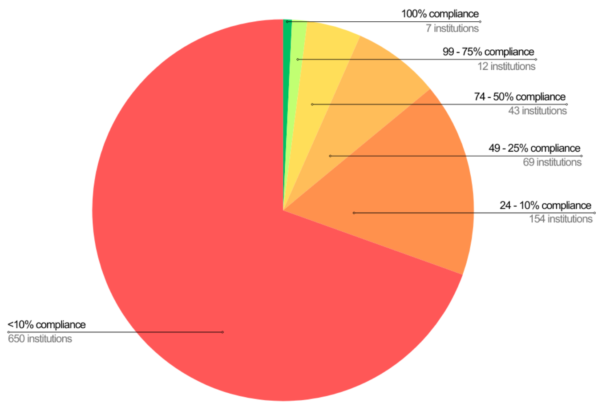
Only 7 of the 935 institutions monitored (0.75%) were found to have achieved full compliance to all of the requirements of proactive disclosure. This included 4 statutory bodies, 2 city councils and a superior court. While a further 3 institutions achieved over 90% compliance, a trend of an exponential decrease in the rate of disclosure was observed:
| Information required to be disclosed | Average disclosure % across ALL institutions | Average disclosure % across institutions with a functional website |
|---|---|---|
| 37 (a) Institution's duties / functions / responsibilities | 26.42% | 50.10% |
| 37 (a) Instiution's structure | 14.65% | 27.38% |
| 37 (b) Direct services provided or being provided to the public. | 37.65% | 70.59% |
| 37 (c) Mechanism of lodging a complaint | 8.02% | 14.20% |
| 37 (c) Details of the complaints received | 1.82% | 2.43% |
| 37 (d) Details of how documents are managed | 2.99% | 4.87% |
| 37 (e) Nature of general publications | 18.07% | 33.87% |
| 37 (e) Procedure to follow to request for information | 6.74% | 11.76% |
| 37 (f) Responsibilities and duties of high ranking officials, their powers and scope of discretion | 7.70% | 14.00% |
| 37 (g) Laws, regulations used by the Institution | 13.80% | 26.17% |
| 37 (g) Policies, principles and norms used by the Institution | 14.12% | 25.96% |
| 37 (h) Details of decisions taken that would affect the public | 19.68% | 36.92% |
| 37 (h) Reasons for those decisions | 17.75% | 33.06% |
| 37 (i) The manner in which suggestions and criticisms on decision-making can be exercised by the public | 4.71% | 8.11% |
| 37 (j) The budget allocated to the Institution | 5.67% | 10.55% |
| 37 (j) Particulars of all plans made by the Institution | 6.95% | 12.58% |
| 37 (j) Proposed expenditures | 3.53% | 6.09% |
| 37 (j) Details of disbursements made | 6.74% | 11.76% |
| 37 (k) Individual remuneration and benefits received by all the employees of the Institution | 4.39% | 8.11% |
| 37 (l) Stages and procedure followed in the decision making process | 5.13% | 8.72% |
| 37 (m) The principles / norms followed by the Institution | 10.16% | 18.86% |
| 37 (m) Mechanisms for supervision and accountability | 4.81% | 8.32% |
| 36 (a) Name of the Information Officer | 7.81% | 14.00% |
| 36 (a) Designation of the Information Officer | 5.99% | 10.55% |
| 36 (a) Contact details of the Information Officer | 8.02% | 14.40% |
The biggest challenges to the proactive disclosure of the required information involved issues related to the websites of state institutions. Currently, there are no legal requirements or standards governing the websites of State Institutions in Maldives and almost half of all of the state institutions monitored did not have a functional website. Several websites were also sometimes inaccessible through the monitoring period. While the proactive disclosure review was able to be completed before the websites were taken down, this posed a challenge for verification, and several websites monitored for this study are now unavailable.
The removal of some information that was noted to have been available during previous Proactive Disclosure Assessments was observed. Several of the URL links where the information was previously available on the institutions’ websites were noted to have been broken and the information unavailable anywhere on the website. As a result, several institutions that had achieved high disclosure rates in previous assessments had since had their proactive disclosure rate fall significantly.
The publication of key information and announcements on institutions’ social media accounts in general is a good thing. However, as the international best practice for the disclosure of the information required to be proactively disclosed under RTI legislation is for the information to be published on institutions’ websites, information published on social media were not considered. Furthermore, publication on social media accounts would not fulfill the requirement for easy access specified in Section 37 of the RTI Act either, since almost all social media websites deliver information via a timeline, meaning information published some time ago would require considerable effort on the part of users to scroll through all of the different posts published since the information was published.
While numerous institutions had improved on meeting their proactive disclosure obligations and had at one point, attempted to disclose all of the required information, it was noted that several institutions had failed to keep the information updated. Most of the information required to be proactively disclosed under the RTI Act have to be published by State Institutions once and only updated very rarely upon change. Conversely, several other areas of information such as details pertaining to the complaints received, decisions taken that would affect the public, budget and expenditure details have to be updated at least once every year.
Similar to how State Institutions are not required to have their websites set up in any certain manner, there is no set way in which State Institutions are required to publish the information required to be proactively disclosed. As the only requirements under the RTI Law is that the information be disclosed publicly in an easily accessible manner, State Institutions have interpreted the requirements in different ways and employed a number of different methods in order to try and fulfill these requirements. While some institutions have set up special tabs or documents on the websites dedicated to the disclosure of the required information, other institutions have disclosed the information in their Annual Reports. Several institutions also opted to provide a list of links to where the information available in different areas of their respective websites can be accessed. The manner in which different areas of information were disclosed by different institutions varied as well. For example, while some institutions published the budget approved by the Parliament for the year, some institutions had only published the estimated budget the institution had submitted to Parliament. While some institutions published a list of high ranking officials at the institution without details of their responsibilities or powers, some institutions published details of the responsibilities and powers of officials without disclosing the details of who the officials in those positions were.
Section 37 of the RTI Act only requires state institutions to proactively disclose the required information in an easily accessible manner and does not limit the disclosure to any specific medium or format. While this requirement could be interpreted and the information published in a number of different ways, only information available on websites were considered for this review, in line with international best practice for the proactive disclosure of information.
Due to an absence of a standardized manner in which information is required to be proactively disclosed, the myriad of ways in which different kinds of information was published by state institutions required judgment calls to be made in deciding whether the legally required information had been made available. The interns hired for the collection of data for the review had little to no prior knowledge or experience of the RTI regime, and the training provided to them was limited to a 2-day workshop. While this meant that the data collectors required constant guidance throughout the monitoring period and that collected data often required verification, the data also reflects a layman’s view on whether or not the required information has been disclosed.
External factors, such as elections or the political contexts were not considered for the review, and the transition of government to the newly elected presidency clashed with the monitoring period, during which time the websites of several institutions were taken down to be changed or maintained. While the review was completed prior to any changes to the websites by the new administration, this limitation posed a challenge for further verification.